Why MCP and A2A Are Changing the Game for AI
Why MCP and A2A Are Changing the Game for AI
Ever since Anthropic introduced the Model Context Protocol (MCP) in November 2024, it's been making waves in AI communities. People are excited, and we've seen a rapid increase in tools and servers supporting MCP. More recently, Google released its A2A (Agent2Agent) protocol, adding another important standard for how AI agents can communicate. You can find many articles and videos explaining the technical details of these protocols and how they make building AI agents easier.
In this article, we'll focus on why the adoption of MCP and A2A by the AI community both companies and individual developers is such a big deal.
A Quick Look Back: The Power of Standards
History shows us that standardization has always been crucial for progress. Centuries ago, trade relied on barter: a farmer might trade grain for a weaver's cloth. But finding a weaver who needed grain, and had cloth to trade, was often difficult. Then, gold became a standard for trade, simplifying everything. Many civilizations adopted it, and later, currencies like the US dollar became global standards for many international transactions, partly due to America's industrial strength after World War II.
Think also of the metric system. This standard for measurement revolutionized science and engineering by making calculations simpler and more precise. It's now used almost everywhere.
Fast forward to the computer age. As the internet grew, its success depended on standard communication protocols. The TCP/IP suite, the internet's foundation, emerged in the 70s and 80s. It includes vital protocols like TCP (for reliable data transfer), HTTP (for websites), SMTP (for email), and FTP (for file transfers) many introduced in the 80s and 90s. The widespread adoption of these standards made the internet the powerful force it is today, helping us innovate and advance science like never before.
The key takeaway is simple: standardization makes things easier, and when standards are adopted globally, they enable growth and help humanity advance.
AI's Next Leap: Beyond Just Smart Models
The true power of AI won't just come from smarter models. It will come from AI agents – powered by these models and equipped with tools and real-world knowledge – working together to help us.
But first, what are these AI agents?
Large Language Models (LLMs) are trained on vast amounts of internet data or Synthetic data created by LLMs themeselves. They don't automatically know your personal or private information. To use LLMs for your personal tasks, you can't easily retrain them on your ever changing personal data. Instead, you need a way to give them access to your information and instruct them. This is where agents come in.
Imagine an agent as your personal assistant. This assistant is very smart (an LLM) and has tools to get things done. If you ask your assistant to summarize your upcoming appointments, they take your request. They then consult their "smart friend" which figures out which tool is needed. If your assistant has access to your calendar tool, they'll use it to get the appointment data, pass it to the LLM, which then summarizes it and gives the summary back to your assistant, who then presents it to you.
AI agents work similarly. They are built using frameworks like LangChain, LangGraph, Autogen or CrewAI (which we'll explore in a future article). Agents connect to LLMs and can access tools like your Gmail, Google Drive, Confluence or Jira. When you give an agent a task, it asks the LLM for a plan. Following the LLM's instructions, the agent uses the right tool, gets the information, and sends it back to the LLM. The LLM then crafts a response, which the agent delivers to the user.
How Do MCP and A2A Fit In
MCP (Model Context Protocol) was inspired by the Language Server Protocol (LSP) used in software development. Before LSP, adding features like auto complete for a programming language in a code editor was a lot of work, and had to be redone for every editor. LSP created a standard way for these language "smarts" to talk to different editors. This meant one Language Server could work with many editors, and editors could easily support many languages.
MCP does something similar for AI. It's an open protocol that standardizes how AI applications (or agents) talk to LLMs, data sources, and tools. Think of it like HTTP for web browsers and servers, or USB-C for connecting electronic devices. MCP provides a common language.
Traditionally, AI agents needed custom integrations for each data source or tool, making things complex and hard to scale. MCP solves this by offering a single, standard way for agents to have ongoing, bidirectional connection with multiple data sources and tools. It uses common web technologies (JSON-RPC 2.0 over WebSockets) for fast, reliable, and continuous connections.
- MCP Host: AI assistants (like Claude Desktop) or development tools (like VSCode) that start the connection.
- MCP Client: Part of the Host, it connects directly to an MCP Server.
- MCP Server: Small applications that connect to specific tools (a Github MCP server allows access to Github).
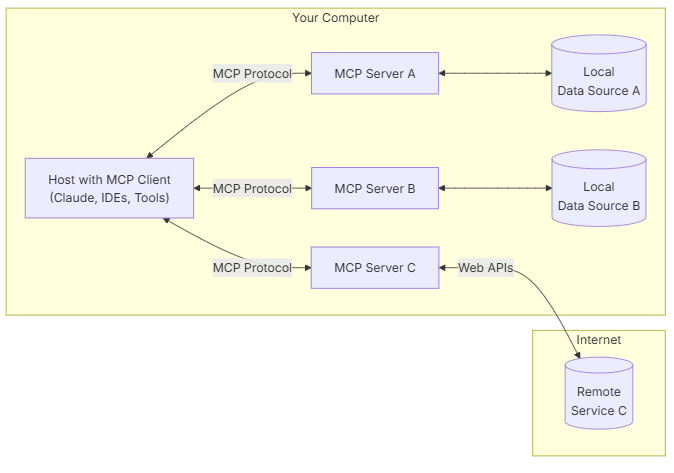
When you make a request to an MCP Host, it can find out which tools are available via MCP Servers. The Host then acts as a go between for you, the AI, and these tools. Support for MCP from leaders at major AI companies like OpenAI, Microsoft, and Google DeepMind is likely to encourage even wider adoption.
A2A is another important protocol that works well with MCP. While MCP focuses on communication within an AI application or between an agent and its tools, A2A is for communication between different agents.
A2A allows one agent (the "client agent") to connect with another agent (the "remote agent") to get information or help with a task. This involves a few key features:
Agent Discovery: Agents can announce what they can do using a digital "Agent Card." This helps other agents find the right one for a job.
Task Management: Agents communicate to complete tasks. The protocol defines how tasks are handled, whether quick or long-running. Agents stay updated on progress, and the result is called an "artifact."
Collaboration: Agents exchange messages to share information, replies, results, or user instructions.
User Experience Negotiation: Messages can include different types of content (like images or videos). Agents figure out the best format, considering what the user's interface can handle.
This is vital. As we create more specialized agents, standard communication allows them to work together easily to tackle complex problems. Think of a software development team: product owners, developers, and testers all specialize in different areas. Clear communication between them is essential for success. Similarly, A2A will be a game changer by enabling specialized AI agents to communicate effectively.
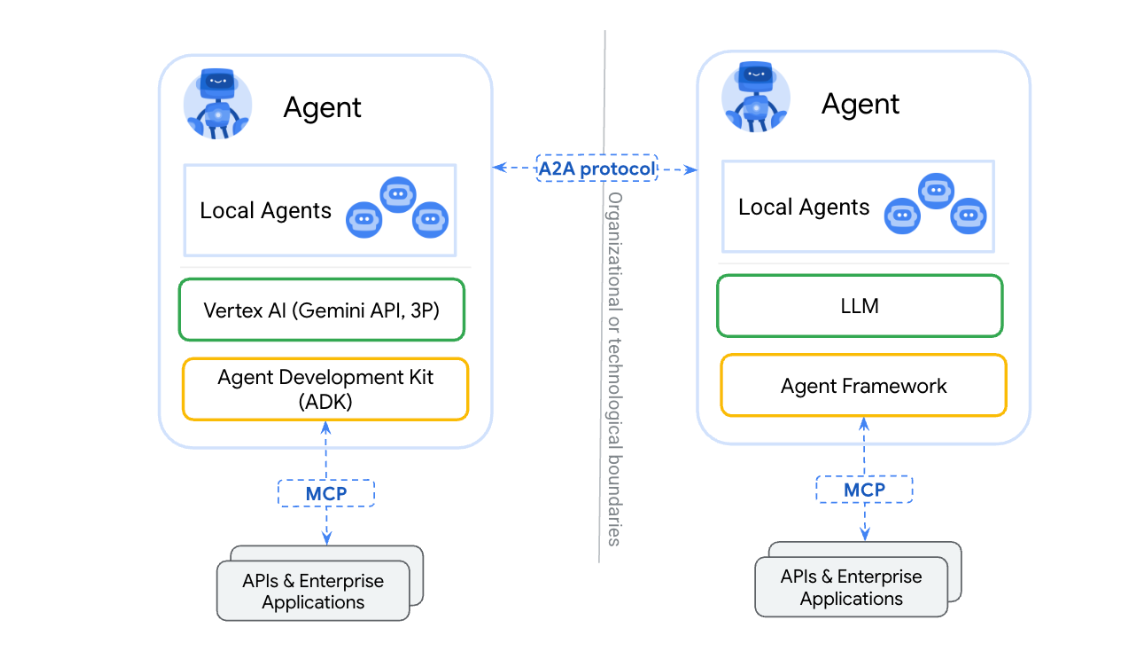
A2A could lead to a new era where AI agents can easily work together, driving innovation and creating more powerful and flexible AI systems.
The Path Forward: Standards for AI Growth
MCP and A2A are more than just technical tools, they are foundational building blocks for the future of AI. For artificial intelligence to be widely adopted and seamlessly integrated into our daily lives and work, common standards for communication are not just helpful they are essential. History has shown us time and again that when we establish and embrace standards, innovation doesn't just accelerate; it flourishes, paving the way for significant growth and advancement for everyone. These protocols are key to unlocking that potential for AI.